how to make 3d dragon drawing
Read Fourth dimension: 15 mins Languages:
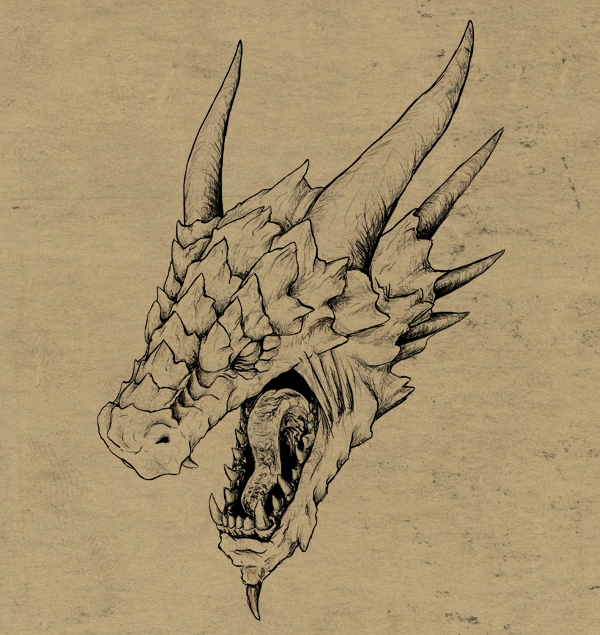

Dragons are cute creatures that, unfortunately, don't exist. This simple fact makes cartoon them quite problematic - is there whatsoever way to draw them correctly? I can prove yous how to draw a dragon head in a realistic fashion, in every pose in 3D space. You just need to consider the basic structure of a skull shape and work from there.
1. View the Skull in 3D Shapes
Footstep 1
Hither's a 3D model of a dragon skull I've created for you lot (you can download information technology and use every bit your reference in any 3D software). I'm going to refer to this 3D model to prove you lot the fundamental areas on the skull. Can you place the upper jaw, the lower jaw and the brain case? You could even pick out the eyeball socket, the nostrils, teeth and horns. If you consider each one of these areas, y'all can build upon information technology to pattern your own dragon. That'due south all we're going to need.


Pace ii
Hither's a plan of the aforementioned skull. Simplified plans are the best style to start a cartoon. This program is yet too complicated, though. There are too many weird angles yous'd need to take care of when turning the head. Let's simplify it fifty-fifty more!


Step 3
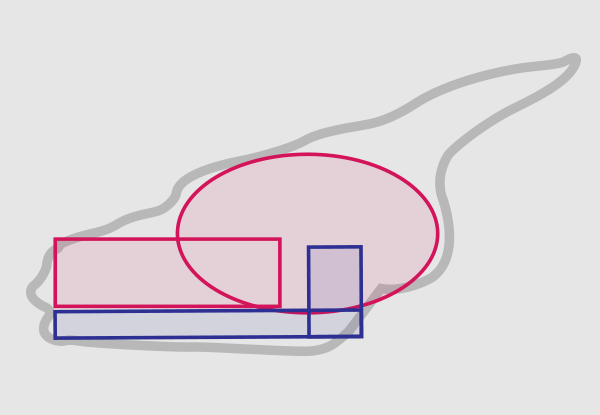
There information technology is! Every bit you lot can see, information technology's less accurate - it doesn't fit the skull's outline whatsoever more than. Still, simple shapes make the pose establishment easier, and we can rework them subsequently to suit our needs.

Pace 4
While the upper function'south movement depends on the neck, the lower jaw tin can move on its own up and down (and sometimes left and correct besides, but pure carnivores can't really chew). The circle point shows the axis of rotation we'll need after. Try looking at other skulls of carnivores for examples of this mechanism, like crocodiles. They have long palates which rotate on a similar axis.


Step 5
OK, so we know how to draw a dragon caput from one side. But if you tried drawing dragons before, you probably guessed how to get this far on your own, equally it's quite intuitive. What you desire to larn is how to create a 3D pose, right? Then, let's create 3D blocks of the 2d shapes that the skull is congenital of.
Basically, nosotros've got an oblate ball, a cuboid and an "L" shape laying flat. These blocks volition permit us build a dragon head!


2. Create a 3D Pose
Earlier nosotros first, let's get technical. This tutorial volition be based on simplified perspective tips. While it'south not "technically" accurate, it'south a good practise to practice the thinking in 3D. How you envision a dragon may be different to how I practice; that is completely fine. However, we're going over the 3D mechanics of a skull for the initial part of the tutorial and this theory work will be valuable for your own creations.
Pace 1
Let's showtime with a ball. It doesn't need to exist perfectly circular, what we do now is just a sketch, a base for something more than.
- If you draw traditionally, keep the sketch low-cal and almost invisible (a difficult pencil may exist proficient for this phase).
- If you draw digitally, go on the sketch on a layer you'll exist able to delete later.
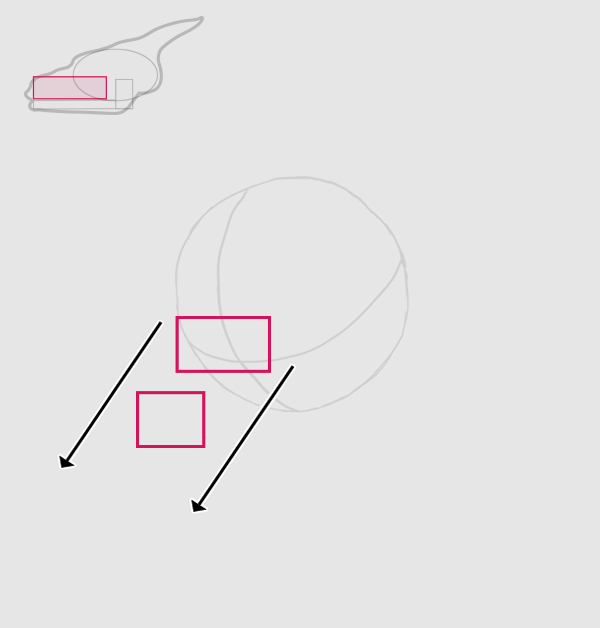
The arrow shows the management our dragon will be facing.


Step 2
Time for the upper jaw. We need to draw the 3D cuboid. Intuitively, we should draw 2 rectangles. As the rima oris is tapered, you'll need to make the rectangle at the front of the mouth smaller.
The vertical altitude should depend on the mouth's length, while their horizontal distance should depend on the arrow's direction. It's only partially right, though.

Stride three
The one-point perspective cube that we draw in geometry classes is, in fact, an incommunicable figure. This ways y'all can draw it, but it doesn't exist in 3D space. Don't believe me? But take any cube and endeavor to place information technology a position to meet a perfect foursquare and a bit of two sides at the same time. Surprised?
To make the mouth more natural, nosotros need to tilt 1 of the sides - a or b. The next step will go into more than detail about this.


Stride 4
Here comes some math! If you're familiar with perspective rules, you lot can skip this stride. The rest of you, don't worry - you don't need to learn everything by heart, these rules are pretty easy to follow:
- When all the sides are the same lengths and the angles are xc degrees, we tin can see a foursquare.
- When you rotate the figure horizontally, the left or correct side appears. The more than you rotate, the shorter
candabecome, so more than of the new side is visible. - When you rotate the figure vertically, the top or bottom appears. The more yous rotate, the shorter
banddgo, so more of new side is visible. - You tin't see both the summit and bottom at the same time.
- You can change the angle between sides to see iii of them at the same time.


Step 5
Let's come back to the dragon. Now create the correct 3D shape. Y'all are gratis to use any lengths and angles for now, but later you'll need to lucifer the other elements to them.


Step vi
We'll draw the lower jaw now. Do you lot call back the "L" shape? Information technology should be longer than the upper jaw, with an boosted part attached to information technology. It also needs to be placed right under the upper jaw.
My rima oris is going to be tapered, so the part in the forepart is smaller then the one backside it. Notice that I attach the bigger part to the back of the upper jaw.


Footstep 7
Since the lower jaw is longer than the upper jaw, and they both showtime at the same point, nosotros need to move the back part a bit deeper. To find the correct direction for it, you can draw two lines beyond the upper jaw's sides. If your rima oris is tapered like mine, you demand to pretend it's a cuboid for a moment.


Step 8
Now simply "slide" the dorsum part across your guides to get the correct distance.


Pace ix
This is the easy part: draw in the rest of the jaw.


The pose is ready! Await... A dragon with its oral fissure closed is a peaceful dragon, just what if we desire to draw a fearsome muzzle seething with anger? See the side by side steps if you want to learn the answer.


3. Describe an Open up Oral fissure in 3D Space
Step 1
If we want an open oral cavity, we need to draw the balance of the "L" shape. Its back, upper part will exist the axis of rotation; we need this axis to define the next pose.


Step 2
Let's open the rima oris as much as possible (a right bending is the limit, in my opinion). A xc degree rotation is quite easy to practise; the top becomes front side and the back becomes top. The correct side merely switches the lengths.


Step 3
We need to find the centre of the mouth. To do this, depict a line beyond the upper jaw and the rotated block. And then describe a vertical line down. The bending betwixt the two lines is 90 degrees, but perspective alters it.


Stride 4
Imagine a huge circle with a eye in the corner of our right bending. Draw simply the function that's betwixt the lines.


Pace 5
An open up rima oris will exist moving along a curve. You can meet the front function of the lower jaw will proceed narrowing while sliding downward, until we finish seeing its front (and the inside is visible instead).


Stride 6
To have the mouth wide open, yous need to draw the front of the rima oris turned away from yous, and then connect it equally commonly with the rotated back part. The lower lip should touch on the bend.


Step seven
Since you know how the closed and fully open mouth looks, you can easily find every transitional position. You simply need to imagine the "L" office rotating over the axis, and the oral cavity sliding over the curve between jaws. Remember to always touch it with the lower lip!


Step viii
This is how my dragon guide sketch looks. If yous're drawing traditionally and your sketch looks very messy now because of all these lines we don't need any more, you can trace the sketch on a new folio. Keep it light! If you lot're drawing digitally, only lower its opacity, lock it, and create a new layer.


4. Form the Basic Structure of the Dragon
Stride 1
Once we take our simple blocks divers, we demand to add more than complicated blocks to pad out the face. When you describe a dragon without thinking near 3D, y'all just draw an centre or eyes, nostrils and horns, and that'due south all. The whole face is flat and unnatural. You demand to plan the face masses beginning, and then depict all the bulges and depressions. See them in 3D!
Again, it's even so in the sketch stage. It means yous demand to keep the new lines light (or on a new layer). Permit's describe the upper jaw first. It should be connected to the ball, only you don't actually demand to be strict with the shape. Apply the pose sketch every bit a guide, just don't trace it.


Step 2
Draw a forehead as well. As you can come across, I didn't worry about the model'southward size at all. It's the direction that matters.


Footstep three
Add the forehead ridges at a whole forehead's width. You tin can even describe them from the olfactory organ to the cease of the head.


Pace 4
The lower jaw is virtually traced, as there's no room for any changes (yet).


Stride 5
Identify the eye in a socket. Where to place it? Ane helpful tip: herbivores generally have their eyes on both sides of the head for the widest field of vision possible (to see an enemy while eating). Carnivores take their optics on the front of the face for a precise sight (compare a horse and a lion). Therefore:
- If you lot want a dragon with gentle look, place its eyes relatively far from the forepart of the face.
- If you want a murderous beast, place its eyes closer to the mouth.
Can you lot guess what kind of dragon I drew?


Step 6
Since all the shapes are nicely defined, nosotros can start drawing for real! Grab a softer pencil or create a new layer and let's go!


5. Draw the Dragon's Features
Step 1
While horns look pretty easy to draw, people tend to have problems with them. Everyone has their own mode, merely if you lot desire your dragon to look natural (so, more realistic), don't make them sharp. Horns wear down when used! Also, straight ones look quite artificial, so bend them a piddling.


Step 2
Dragons are by and large covered with small scales that resemble peel (like snakes), or with big plate-scales. While pocket-sized scales are very easy (and boring) to depict, plates are what make them look massive and armored. Once you learn how to draw them, you'll see it's much faster than covering whole trunk with a bazillion trivial ellipses! Then, three tips:
- You lot can imagine a single plate-scale is a paw with 3 fingers. This hand tries to embrace the surface information technology's laying on, and then near of the fourth dimension we'll encounter only a one-half of information technology (two fingers).
- When the scales abound bigger, they don't just increase their size - they're like fractals. Information technology works like a growing tree that gets more branches with a time.
- Scales lay upon each other, but they're not glued together; when their base is bending, they "open".


Step three
When you lot describe a scale (or annihilation made of natural material), it doesn't demand to be perfect. Nature isn't perfect! Scales aren't made of plastic; they accept been growing for a long time, in the rain and cold; they have been hit and scratched, and that has changed them. (Or, if your dragon is made of adamantium, naught changed them. Perfection is fine in that example.) Don't exist afraid to raise your pencil and come dorsum to the line you simply started - long, shine lines give a cartoony look. Don't endeavor to fix your lines either, or you'll become a mess.


Step 4
Since nosotros know how the scales work, nosotros tin starting time to wearing apparel our dragon. First, we'll accept care of the eyebrows. They look just like tapered cylinders, and then it'south like shooting fish in a barrel to imagine how the scales should be placed. First with the i on the front - the simply one that will be fully visible. Then draw another, a fiddling bigger, and so on. Every other scale may be more than complicated than the previous ane, merely every bit if you were drawing them growing!


Footstep 5
At present, place your scales from the nose to the end of the head. This time they're quite similar, as the surface they're laying on barely changes its shape. They as well can lay flat.


Step half-dozen
I'm not going to teach yous near an heart's shape, because they can be really different. Nonetheless, there's i universal thing: the eye is placed in the centre socket, covered with eyelids, and protected with two big os masses - the forehead ridge and the zygomatic bone. There are ii things to remember:
- If dragon's peel is very thick, the eyelids are probably quite thick besides - therefore, when the heart is open up, the eyelid volition accept a strong wrinkle.
- There's a right bending betwixt the top of the zygomatic bone and the eyeball, and then keep that in listen when changing the pose.


Step 7
This is how I drew the eye:


Step 8
Fourth dimension to draw the rest of the mouth. Depict it with your hand shaking - this way you'll go a lot of interesting shapes, which are and then much better than boring smoothen lines. Also, tin can you see the footling low? It's not required; yous can continue your rima oris circular if you lot want.


Step 9
Let's depict the lower jaw! It's going to exist quite complicated, because of all the teeth and then on, and then allow'due south take it tedious. Get-go, draw the forepart part of the jaw (a shaking paw will help y'all once again). We likewise need to add this stiff jaw muscle that opens the rima oris. The bigger the angle of opening, the more stretched the muscles. This tension adds a lot to the picture!


Step 10
Generally, teeth are going to apply the aforementioned bend to slide over when the mouth is opening, because the upper and lower ones want to run into - just similar the jaws. Also, don't forget:
- Teeth wear out too! Don't make them all pointy or they'll seem unused.
- The kind of teeth tells a lot virtually your dragon. Should they exist like a T-Rex's, or more than like a lion'southward? What does it swallow, and how does it chase?
- Dragons can't expose their gums like wolves, considering their pare is much harder, just they withal should exist visible when the mouth is open.


Stride 11
A tongue is usually plump, so don't make it flat. It needs to aid the huge beast swallow quite large things, after all! Points to consider:
- If your dragon can eject its tongue long out of the oral fissure while roaring, ask yourself: what'southward the signal of this? I don't really know any animal that does information technology, and so you lot demand to find a good reason to brand it "realistic".
- A forked tongue is an organ of smell. Snakes moving picture their tongues out all the time and, theoretically, your dragon should do the same if information technology has a forked tongue. Otherwise, it's pointless!


Step 12
The head is almost consummate, so let's but add an element to merge both jaws together. You can utilize bony wings here, boosted horns and spikes, anything you similar! Just remember - it all should serve a purpose (for example, to look bigger or more attractive for a potential mate).


Step 13
So, the head is done! It's still just a line fine art, so if y'all desire to learn how to make information technology more attractive, see the side by side stride.


half-dozen. Add a Spark to Your Cartoon
Step 1
We're going to do the inking now. Digital artists are in a improve position hither, just traditional markers and ball pens will practise besides!
Our pic is fabricated of lines of about the same width. Stress some of them to add importance to the various areas.


Step 2
Add some darkness to wherever it's needed. Here, I want to show the difference betwixt the within and the outside of the oral cavity.


Footstep three
Encompass the horns and teeth with thin curves. They should exist thinner than about of the lines that build the picture.


Stride four
Employ the same thin lines to sketch shaded areas. Continue it loose and fast. When you want to darken a place, cross the lines, just don't change the pencil!


Step 5
Here is what I've got by adding depth to the scales.


Step 6
Expect at your picture and cheque whether it needs whatsoever more than contrast. If a identify is already covered with lines and you lot want to make it darker, you can use a bigger castor or softer pencil at that place.


Crawly Work, You're Now Washed!
You lot've merely learnt how to create a 3D pose and draw a disarming dragon head. I hope yous liked it! Experience free to come back here any time if y'all need a quick reminder.

stevensonuself1938.blogspot.com
Source: https://design.tutsplus.com/articles/how-to-draw-a-realistic-dragon-head-in-3d-space--vector-14639
0 Response to "how to make 3d dragon drawing"
Post a Comment