Skyrim
- For the Nords' homeland, see Skyrim.
The Elder Scrolls Five: Skyrim is a single-actor role-playing video game developed by Bethesda Game Studios and published by Bethesda Softworks.
It is the fifth installment in The Elder Scrolls action/adventure RPG fantasy video game series, and follows The Elder Scrolls Iv: Oblivion by approximately 200 years, during the Quaternary Era. The game was announced on Nov xi, 2010 at the Spike Video Game Awards in Los Angeles, with a release date of November 11, 2011. Information technology features Radiant A.I., forth with Radiant Storytelling or Radiant Story, to help heighten quests, and a new and improved graphics engine.[i] [2]
Contents
- i Plot
- 1.i Narration
- 2 Setting
- 3 Gameplay
- three.ane Travel
- 3.2 Skills
- three.three Gainsay equipment
- 4 Compared with previous titles
- 4.ane Combat
- 4.2 Lockpicking
- 4.three Spells
- 4.4 Bogus intelligence
- 4.v Followers and spouses
- 5 Skills
- 5.i The Mage
- 5.2 The Warrior
- 5.three The Thief
- 5.4 Leveling up, classes, and customization
- 6 Races
- 7 Gainsay
- 7.ane Enemy leveling system
- viii Armor
- 9 Graphics and interface
- 9.1 Radiant AI
- nine.2 Radiant story
- ix.3 Heads-up display (HUD)
- 10 System requirements
- 10.1 Minimum
- x.two Recommended
- 11 Official add-ons
- 12 Editions
- thirteen Evolution
- 13.1 Concept fine art
- 14 Gallery
- 15 Meet as well
- xvi External links
- 17 References
Plot
- Main article: Main Quest (Skyrim)
Two hundred years take passed since the events of The Elder Scrolls IV: Oblivion, and it is now 4E 201. The High King of Skyrim has been killed, and the threat of Civil War looms over the state of Skyrim; One side wishes to secede from the weakened Third Empire, while the other wishes to remain a office of information technology. To make matters worse, this schism is the final effect in a prophecy foretold by the Elderberry Scrolls that will lead to the return of the dragons under Alduin, the Nordic god of devastation.
The histrion starts the game on a cart heading for the chopping block later on being caught with the Stormcloaks in an ambush by the Majestic Legion. As the player lays their caput on the chopping block, the dragon Alduin attacks. In the midst of the chaos, Hadvar, several Stormcloaks, along with their leader and fellow prisoner, Ulfric Stormcloak, assistance in the player's escape. The player may choose betwixt the assistance of Ralof, the Stormcloak who arrived with Ulfric, or Hadvar, the Imperial soldier tasked with reading off the names of the prisoners being sent to their execution. Later profitable and gaining the favor of Jarl Balgruuf the Greater, The player later learns that they are Dovahkiin, or Dragonborn, a person charged with the duty of defeating Alduin and the dragons. Eventually, the player meets Delphine, and Esbern, two of the last remaining Blades, and becomes the pupil of the esteemed Greybeards of Loftier Hrothgar.
Narration
Y'all should have acted. They're already here.
The Elder scrolls told of their return.
Their defeat was merely a filibuster.
From the time after Oblivion opened.
When the sons of Skyrim would spill their own blood.
But no i wanted to believe. Believe they even existed.
And when the truth finally dawns, it dawns in fire.
But at that place is one they fear.
In their tongue, he is Dovahkiin - Dragonborn!
Setting
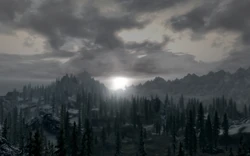
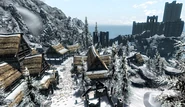
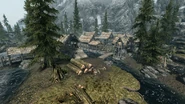
Set in the snowy province of northern Tamriel, Skyrim is home to lush landscapes.
The fifth installment of The Elder Scrolls takes place in Skyrim, where peace and stability is threatened by the ongoing civil war betwixt a Nordic separatist faction called the Stormcloaks and the Empire'southward Purple Legion, likewise as the return of the dragons under the game's main antagonist, the great dragon Alduin.
Skyrim is the northernmost region of Tamriel and its geography consists of mountains, snowy tundras, pine forests, rural countrysides, and arctic plains. Its architecture and atmosphere are very similar to the town of Bruma in The Elderberry Scrolls 4: Oblivion. Although it is roughly the aforementioned size equally Oblivion's Cyrodiil (approximately 41 square kilometers in surface area or 15.viii foursquare miles), it is the least populated of all regions in Tamriel. Although at that place are only five cities within the province, they are complemented with smaller townships dotted through the land with huge swathes of wilderness separating them all.
There are over 150 dungeons scattered across Skyrim. Fast-traveling is a returning feature, allowing the player to instantly travel to whatever marked location that has been previously visited.
New creatures to the serial include Giants, Frost Trolls, mammoths, Frostbite Spiders, Ice Wraiths, Hagravens, and Dragons. There are besides children present in the game for the first time since Daggerfall, where they fabricated several appearances.
Gameplay
Travel
- Main article: Travel (Skyrim)
Skyrim retains the traditional open-world gameplay found in the Elder Scrolls series. The mural can exist freely roamed either in start person or third person signal of view. Skyrim gives the pick of traveling on horseback, running, or walking. When a new location is discovered, information technology is added to the map. Thenceforward, the location tin can be fast-traveled to.
Skills
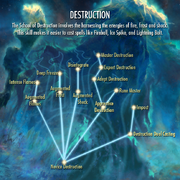
The Destruction perk tree.
- Main commodity: Skills (Skyrim)
Eighteen unlike skills are employed to collaborate with the earth. Some skills are used specifically for combat, such equally the weapon-based skill I-Handed and the magic-based skill, Destruction. Other, more passive, skills, let for the crafting of items such as through Smithing or enchanting. Leveling up happens when any of these 18 skills are used to a certain bespeak. Skills level up as well, and the thespian'due south overall level is contingent upon the levels achieved with each skill.
The traditional Role-Playing Game concept of a class system has been abolished in Skyrim; it has been supplanted with a very gratuitous-form system that allows the use of perks. Perks unlock special abilities on each of the eighteen skill trees. Ane perk is awarded for each character level increase.
Perks are skill-specific abilities, organized in a system of branching groups chosen "skill trees." One of many perks can be chosen from each time a level is gained. Player leveling extends somewhat further than in previous Elder Scrolls games, reaching a maximum level of 81 when all skills have been increased to 100; this limit is due in part to a significant sharpening of the experience curve for leveling after 50.[3]
Gainsay equipment
Weapons and armor may be crafted by players at forges, and all gear may be improved upon using other crafting facilities provided that the actor possesses the requisite skill levels and perks; this allows for a wide range of equipment variation and lets those characters with the highest skills outfit themselves with accordingly powerful equipment. The player tin besides enchant their weapons for extra damage and gain special abilities from them.
Compared with previous titles
Combat
Melee gainsay has been overhauled from Oblivion, with weapon attacks taking a less fluid - and much more than realistic - pace. Weapon types such every bit the previous Blade and Edgeless take been condensed into I-Handed and 2-Handed weapon skills, with the war axes, maces, and swords each benefiting differently from perks inside these skill copse; for example, axes can add together extra bleeding impairment, swords strike rapidly and can proceeds a higher take a chance of a disquisitional hit, and maces proceeds armor penetration while striking at a slower rate. Special "finishing moves" have also been added, which evidence a wearisome-movement killing blow such as impalement or decapitation beingness delivered past the player graphic symbol.
Lockpicking
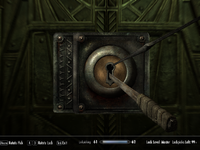
Lockpicking in Skyrim no longer shows the pins of the internal lock.
- See also: Lockpicking (Skyrim) and Security (Oblivion)
Lockpicking has been inverse since Oblivion. It is no longer in a pivot and tumbler manner, instead information technology is similar to Fallout 3/New Vegas, another game from Bethesda. On panel versions of the game, both analog sticks are used to manipulate the tools and open the lock. The pick is controlled with the left stick and a tension wrench with the correct. PC versions of the game utilise the mouse and the WSAD keys instead. The pick can be rotated around the summit of the lock within 180 degrees.
A spot within the rotation allows the lock to open, the spot being larger with easier locks and becoming much smaller with harder difficulty locks.
Spells
- See as well: Spell Tomes (Skyrim) and Spells (Oblivion)
Spell mechanics accept inverse significantly in Skyrim equally compared to Oblivion. Burn down, frost, and shock spells at present have boosted effects; fire deals "burn damage per 2nd" when the target catches on fire, shock does an additional 50% of damage to the victim's Magicka, and frost spells deal 100% of their damage to the victim'south Stamina. Custom spells can no longer be created, and considering the form system has been eradicated, no bonuses spells are given for selecting a particular School of Magicka during graphic symbol creation. Instead, all spells are learned through the reading of Spell Tomes, the way the Oblivion DLC functioned.
Quests have been implemented to gain Main-level spells in each school. Each spell has a special casting animation and is often more potent than their bottom counterparts. The school of Mysticism has been removed entirely from the magic system, with its spells beingness redistributed to other magic schools. For case, Soul Trap has been distributed to Conjuration, while detection spells now vest to Alteration. From the schoolhouse of Alteration, the open up lock, burden, and plumage have been removed entirely.
Bogus intelligence
Skyrim makes use of the radiant artificial intelligence system created for Oblivion, which has been updated to permit characters to "do what they want under extra parameters." The updated system allows for greater interaction between characters and their environments; characters now perform tasks such as mining, milling, smithing, potion-making, cooking, and other menial labors, and volition continue to go about such business if the player speaks to them while they are working.
Followers and spouses
Player marriage has been implemented; through a brief courtship process, the role player may ally select characters of either gender, offering a housemate too every bit a range of spouse-exclusive benefits. Players can recruit followers in the game, they tin can exist found in taverns or some stores or by gaining a championship in a certain hold. When the role player becomes the Thane of a certain hold they automatically get a companion to assist them.
Skills
In that location are eighteen skills in all, six for each style of play (Magic, Combat, and Stealth). They are as follows:
The Mage
- Alteration
- Conjuration
- Destruction
- Illusion
- Restoration
- Enchanting
The Warrior
- Archery
- Block
- Heavy Armor
- Ane-Handed
- Two-Handed
- Smithing
The Thief
- Abracadabra
- Light Armor
- Lockpicking
- Pickpocket
- Sneak
- Speech
Acrobatics and Athletics accept been entirely removed from the game. Fall harm scales with distances and players may run more apace by using the newly implemented sprinting function both in and out of combat.
Leveling upward, classes, and customization
The leveling mechanic in The Elder Scrolls V: Skyrim is similar to previous titles, with the role player leveling upward after enough skills accept, themselves, been leveled upwards through apply. Game director Todd Howard stated that the game's "mathematical" level cap is seventy;[4] however, the Prima Official Game Guide states the level cap is "around eighty."[5] Ane of the largest differences from previous Elder Scrolls games is that you no longer specify a group of major and pocket-sized skills; instead, all skills are treated the aforementioned, and all skills contribute towards leveling up.[6] As a effect of this change, in that location is no longer any grade pick component to character creation.
A significant new feature to The Elderberry Scrolls serial is the addition of a total of 251 perks, one granted each level, which allow for farther specialization. Each skill is presented as a constellation, built upwardly of node stars representing the perk tree, within a firmament. For example, a thespian using one-handed weapons could specialize in maces with a perk that ignores opponents' armor, select a perk granting swords an increased chance of landing a critical striking or prioritize axes by choosing a perk that makes enemies drain, causing damage over fourth dimension.
Character visual customization has been further refined from previous Elder Scrolls games, introducing new customization options such every bit pre-built beards and faces, state of war paint and scars, and otherwise enhanced facial construction. Torso size is also at present an editable feature, forth with different presets for well-nigh all facial features.
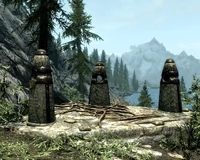
Guardian Stones supercede the need for birthsigns.
Too new to the Elder Scrolls serial are the Guardian Stones: large, carved obelisks scattered throughout the game world found singly or in a single group of 3 (about the game start area). By activating the stone of your selection, your grapheme is granted ane or more than bonuses or powers; a new stone may exist selected later on, but only one stone can exist active at a time. There are xiii Guardian Stones, respective to—and replacing—the thirteen birthsigns of previous games.
Unlike the prior Elder Scrolls games, which featured eight attributes that could be increased through leveling, Skyrim has only three values to increase, one of which can exist selected each level: Health, Magicka, or Stamina. This was done for the dual purposes of simplifying the leveling process and reducing unnecessary statistics, every bit the 8 attributes were considered to be only a ways of increasing the 3 to a higher place values.
Races
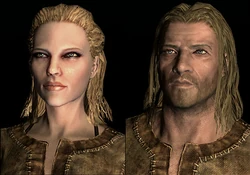
Nords, the natives of Skyrim, are a playable race.
- Master article: Races (Skyrim)
Players can craft their character using one of the ten races of Tamriel—Imperials, Nords, Redguards, Bretons, Dunmer, Altmer, Bosmer, Orsimer, Khajiit, and Argonians. Each race is characterized by a specific ability and passive bonus, too as starting with a few skills at slightly higher levels. For case, High Elves begin the game with 50 extra magicka, the power to drastically increment their magicka regeneration charge per unit for threescore seconds in one case per 24-hour interval, and five extra points in several of the magic skills.
Playable races include:
- Altmer (High Elves – Summerset Isles)
- Argonian (Reptilians, or Lizards – Black Marsh)
- Breton (Humans – High Rock)
- Bosmer (Woods Elves – Valenwood)
- Dunmer (Dark Elves – Morrowind)
- Majestic (Humans – Cyrodiil)
- Khajiit (Felines – Elsweyr)
- Nord (Humans – Skyrim)
- Redguard (Humans – Hammerfell)
- Orsimer (Orcs – Orsinium)
There are also two unplayable races which are mentioned throughout the game:
- Falmer – The Snow Elves were a race that inhabited Skyrim long before the Nords. The Elves were massacred by the Nords and fled secret. Here they found refuge with the Dwemer, ostensibly on the condition that they eat poisonous fungi causing blindness. The effects of the fungi and their life underground have morphed them into the Falmer seen frequently in caverns, Dwemer ruins and Falmer hives.
- Dwarves (Dwemer) – A long-lost race that once lived throughout Vvardenfell, Skyrim and Hammerfell. They preferred the use of technology over magic, every bit is axiomatic in the Dwemer ruins, Animunculi, and technological artifacts encountered throughout Skyrim, as the machines they created are withal working to this twenty-four hours doing their duty to protect what is left of the Dwemer (translated as "Deep Elves").
Gainsay
- Main article: Combat (Skyrim)
Gainsay has undergone a significant overhaul from previous installments of the series; damage is proportionally higher than in the past and the pace of melee combat has been significantly slowed from Oblivion. Special spell furnishings and an increase in the utility of bows through the revised skill of Archery make for oftentimes more dangerous—and consequently more tactical—combat.
A major new aspect of combat, too as significant plot device in the game, is the presence of Dragon Shouts or Thu'um equally referred to in-game, which utilise the language of dragons to manifest the Shout-users' vital power as "Thu'um," which tin have various powerful furnishings—these include burn jiff, a sort of "force" push, and a demoralizing roar, among other effects. The shouts tin can be used intermittently and may exist longer or shorter if more than than one give-and-take of each Shout's three constituent words is known.
Stealth-based combat has also been improved with the presence of a cinematic "assassination" impale move that involves the player silently reaching up and slitting a grapheme's throat if the damage of the sneak set on is sufficiently high. Additionally, stealth detection and sneak assault damage bonuses are governed by perks that tin can plow a proficient sneak into a fearsome opponent, fifty-fifty giving the ability to turn briefly invisible in the midst of combat past sneaking.
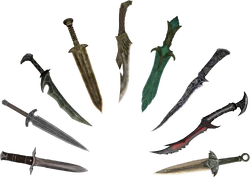
Various daggers in Skyrim.
1-handed weapons include swords, war axes, maces, and daggers; while two-handed weapons include greatswords, battle-axes, and warhammers. Bows and Staves feature as the game's only distanced weaponry. Weapons follow a material progression like to that of Oblivion, starting at iron weapons and ending with Daedric weapons.
Enemy leveling system
Due to the highly criticized leveling system of Oblivion, enemy leveling is handled in Skyrim using a method similar to Fallout three; some locations are ready independently of the thespian's level and will not be reasonable for the role player to attempt to take on at a lower level, whereas other areas will take enemies and boodle ready co-ordinate to player level at the time of the player's first entry into the location. In the second instance, the enemies will stay at that level adamant past the actor'due south commencement entry, pregnant that a histrion returning to a location visited early in the game volition exist able to clear the location of foes with greater ease.
Armor
- Main article: Armor (Skyrim)
Armor has been condensed somewhat further from Oblivion; rather than independently present cuirasses and greaves, the game features "armor," which unifies the two into a single piece of equipment. Helmets, gauntlets, and boots remain unchanged from Oblivion. Equipment weight has generally been re-scaled, making even the heaviest of heavy armors more realistic in weight; this is due in part to the significantly greater limits on the maximum inventory acquit weight the player can achieve in Skyrim. Heavy and lite armors remain as the ii bachelor categories, and each follows a somewhat different fabric progression, with calorie-free armor favoring hides, furs, and leathers until loftier levels, while heavy armor favors metallic throughout its class. Additionally, armor and weaponry no longer degrade with use and thus practice not require any fashion of upkeep. Instead, weapons and armor can exist improved at a grindstone or workbench, respectively.
Graphics and interface
Skyrim uses a new engine developed in-house by Bethesda, called the Creation Engine. The CE was designed with advanced graphics, long draw distances, and variable environments in heed, and is capable of implementing features such as uneven weather effects, more realistic weather simulation based upon distance and geographic region, more realistically flowing water, and ecology effects similar rain and snow having realistic interaction with obstacles.
The game does not currently back up a four:3 attribute ratio screen. Many menus and text are cut off the screen when this feature is attempted.
Radiant AI
The CE allows the utilise of a new and improved version of Oblivion's Radiant A.I. organisation to govern character throughout the game world. With the new arrangement, developers may assign characters a wide diverseness of tasks and characteristics, giving each of them actions that complement his or her unique personality and thus deepening player interaction with the characters of Skyrim. Characters now come in much more interesting varieties, from heavy drinkers to hard workers, layabouts to vigilant adventurers, and serve every bit a much greater office of the game than in Oblivion.
Radiant story
Skyrim introduces the Radiant Story system, which governs quests and how they function. Radiant Story dynamically alters side quests based on the player's actions, and tailors them to the player's abilities and progress within the game. As an example, the thespian might be sent off to a dungeon that has non been previously explored and face enemies that are defeated most finer with the thespian'due south preferred combat way. It also randomly generates unique events and encounters, taking influence from Bethesda's previous game Fallout iii; this includes character interaction such as a courier delivering quest missives or letters from significant figures, or hired thugs seeking out and attacking the player.
Heads-upwardly display (HUD)
- Main article: Character Menu (Skyrim)
The new in-game HUD has been redesigned from previous TES titles to be more than streamlined and efficient, which is accomplished while besides affording greater immersion for the role player. Gauges indicating magicka, stamina, and health fade invisible when full, and only come into view when in apply; certain elements such as Oblivion's spell timers and breath meter accept been completely removed. The compass from Oblivion, featuring quest markers and a cooldown indication feature for Dragon Shouts, has been cleaned up and relocated to the top of the screen.
The menu system has likewise been altered significantly in Skyrim. Now, activating the grapheme menu in-game takes players to a sort of compass, featuring Inventory, Skills/Level-Up, Magic, and Map. Each of these concisely displays the obvious features, with some significant changes from Oblivion. All items in-game are rendered in total 3D within the inventory screen, assuasive the histrion to more thoroughly examine them without needing to equip them or driblet them into the game world. For spells, this is achieved through displays of magical effects when a spell is highlighted. Likewise, the in-game map is a 3D, topographical representation of Skyrim, with location markers, quest guide arrows, and the power for players to fast travel and place their ain guide arrows that will appear upon the player compass in a fashion similar to the quest guides.
Organization requirements
Minimum
- OS: Windows vii/Vista/XP PC (32 or 64 bit)
- Processor: Dual Core 2.0GHz or equivalent processor
- Memory: 2GB System RAM
- Hard Disk Space: 6GB free HDD Infinite
- Video Bill of fare: Straight Ten 9.0c compliant video card with 512 MB of RAM
- Sound: DirectX uniform sound card
Recommended
- Processor: Quad-core Intel or AMD CPU
- Retentiveness: 4GB Organisation RAM
- Video Bill of fare: DirectX ix.0c compatible NVIDIA or AMD ATI video card with 1GB of RAM (Nvidia GeForce GTX 260 or higher; ATI Radeon 4890 or higher)
Official add-ons
Three add-ons accept been released for Skyrim, all of which were "timed sectional" for the Xbox 360. They were later released on other platforms, and are included in several re-releases of the game.
- The Elder Scrolls 5: Dawnguard
- The Elder Scrolls Five: Hearthfire
- The Elderberry Scrolls V: Dragonborn
Editions
A Legendary Edition containing the DLCs Dawnguard, Hearthfire, and Dragonborn was released on June 4, 2013.[source?]
On June 12th, 2016, Bethesda appear that a remastered version of the game, The Elderberry Scrolls V: Skyrim Special Edition, would be released for the PC, Xbox I, and PS4 on October 28th, 2016. The remastered version will include improved graphics, such as snow shaders and volumetric God rays, and will also include the ability to download mods on the main carte du jour.[7] People who own the game on Steam and have either the Legendary Edition or all three add-ons will exist able to download the remastered version for complimentary.[8] Versions for the PlayStation VR and Nintendo Switch were released on November 17th, 2017. and a stand-solitary virtual reality (VR) version for Windows was released in April 2018.
A miniature, sound-focused version of the game was released for the Amazon Alexa under the title The Elder Scrolls 5: Skyrim Very Special Edition on June 10, 2018.[9]
On Baronial xix, 2021, Bethesda announced that a new version of the game would be released for its 10th ceremony, called The Elderberry Scrolls V: Skyrim Ceremony Edition. The Anniversary Edition will contain the Special Edition, all DLCs, and 74 Creation Gild mods; all 48 currently bachelor mods, plus 26 new unreleased ones, adding to a total of 500+ new gameplay elements to Skyrim.[10]
Development
On 18 July 2018, in an interview with The Guardian, Todd Howard stated about the purpose of the game, "People wait at Skyrim and say, 'That's a dragon-killing power fantasy,' but the actual underlying theme was: practise you take a nationalistic view of your ain country, or look at the whole world? I think that's notwithstanding pretty topical today. The matter that helps with [genre fiction], whether that's scientific discipline fiction or fantasy or post-apocalyptic, is that it lets you handle themes like racial stereotypes in means that you don't find at first, and and then become very obvious." [eleven]
Concept art
Adam Adamowicz created much of the concept art for Skyrim.[12]
Gallery
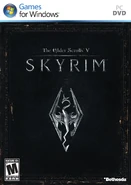
The official cover for the PC version of Skyrim.
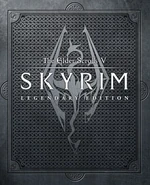
Legendary Edition cover.
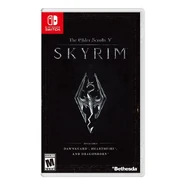
Nintendo Switch cover.
Skyrim VR cover.
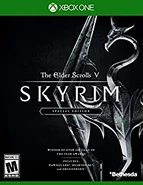
The encompass for Skyrim Special Edition (Xbox ane Edition)

Autorun launcher for the Legendary/Vanilla Edition.

Title screen, without the text.
Map.
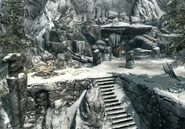
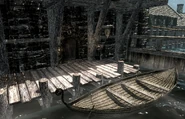
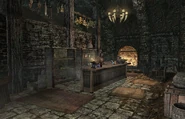
The interior of Eligrim's Elixirs.

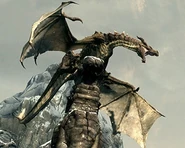
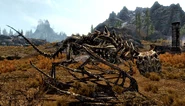
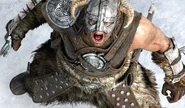
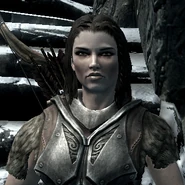
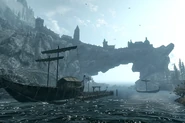
Lydia, a typical non-player grapheme.
See also
- Platforms
- The Elder Scrolls V: Skyrim Legendary Edition
- The Elderberry Scrolls V: Skyrim Special Edition
- The Elder Scrolls 5: Skyrim Very Special Edition
- The Elder Scrolls 5: Skyrim Ceremony Edition
External links
- The Elder Scrolls official site
- Skyrim forums
- Archived Skyrim forums
References
- ↑ The Elder Scrolls V: Skyrim. www.elderscrolls.com (December 11, 2010). Retrieved on Dec 11, 2010.
- ↑ Christopher Grant (December 11, 2010). Skyrim: Elderberry Scrolls 5 coming 11/11/11. www.joystiq.com. Joystiq. Retrieved on December eleven, 2010.
- ↑ Elder Scrolls 5: Skyrim: Prima Official Game Guide
- ↑ http://www.gameinformer.com/b/podcasts/archive/2011/02/03/toddhowardse.aspx
- ↑ Elder Scrolls V: Skyrim: Prima Official Game Guide
- ↑ http://world wide web.gameinformer.com/b/news/archive/2011/01/26/the-art-of-skyrim.aspx
- ↑ E3 2016: Skyrim Special Edition Officially Headed to PS4, Xbox One, PC this twelvemonth
- ↑ Post on Twitter past Bethesda
- ↑ #BE3 | 2022 Bethesda E3 Showcase - 6/x at vi:30pm PT
- ↑ Join Us on eleven/xi for the Skyrim tenth Anniversary Fan Celebration!
- ↑ The Guardian: The Elder Scrolls 6, Starfield and the future of video game giant Bethesda
- ↑ Shawn Sines (May fifteen, 2008). Fallout 3 Dev Diary on Conceptual Pattern. FileFront.
| Chief Series | |
|---|---|
| Arena • Daggerfall • Morrowind (Tribunal | Bloodmoon) • Oblivion • (Knights of the Nine | Shivering Isles) Skyrim (Dawnguard | Hearthfire | Dragonborn | Legendary Edition | Special Edition | VR | Very Special Edition | Anniversary Edition) • 6 | |
| Spin-offs | |
| General | Battlespire • Redguard • Heart of Argonia • Paradise Sugar • Blades |
| Travels | Stormhold • Dawnstar • Shadowkey • Oblivion Mobile • Oblivion PSP |
| Online | Imperial City • Orsinium • Thieves Guild • Dark Brotherhood • Shadows of the Hist • Online: Morrowind Horns of the Reach • Clockwork City • Dragon Bones • Summerset • Wolfhunter • Murkmire Wrathstone • Elsweyr • Scalebreaker • Dragonhold • Harrowstorm • Greymoor Stonethorn • Markarth • Blackwood • Waking Flame • Deadlands • High Island • Smolder Scrolls |
| Legends | The Fall of the Dark Brotherhood • Heroes of Skyrim • Render to Clockwork City • Houses of Morrowind Isle of Madness • Brotherhood War • Moons of Elsweyr • Jaws of Oblivion |
| Strategy Guides | |
| Loonshit Transmission • Codex Scientia • Daggerfall Manual • The Daggerfall Chronicles Battlespire User's Guide • Battlespire Athenaeum • The Redguard Companion • Volume R • Morrowind Manual The Morrowind Prophecies • Oblivion Game Guide • Skyrim Game Guide • Hero's Guides to The Elder Scrolls Online | |
| Books | |
| The Origin of Cyrus! • Pocket Guide to the Empire, First Edition • Pocket Guide to the Empire, Third Edition The Infernal Urban center • Lord of Souls • The Art of Skyrim • Tales of Tamriel (The Land | The Lore) The Skyrim Library (The Histories | Human being, Mer, and Beast | The Arcane) • The Official Cookbook | |
| Merchandise | |
| Merchandise • Call to Arms • Bethesda Pinball • Skyrim Monopoly | |
stevensonuself1938.blogspot.com
Source: https://elderscrolls.fandom.com/wiki/The_Elder_Scrolls_V:_Skyrim
0 Response to "Skyrim"
Post a Comment